SCOA banners

The Community Connection at the Sealy Center on AgingStay Connected. Stay Engaged. Stay Inspired.

Welcome

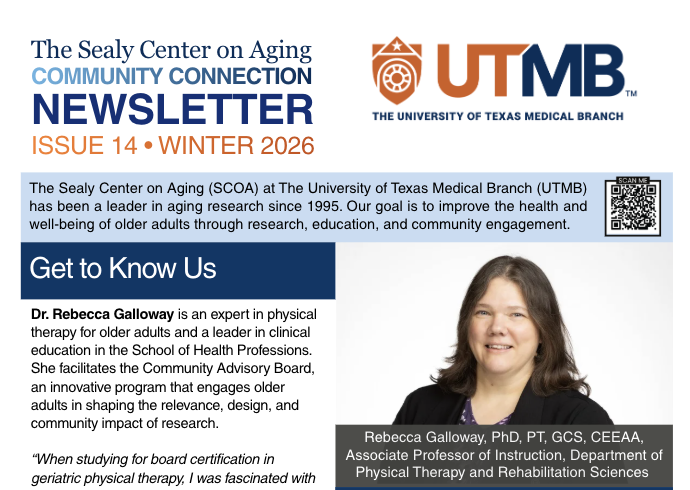
At the Sealy Center on Aging, we believe that growing older should mean growing stronger, through knowledge, community, and meaningful opportunities. That’s why we created the Community Connection, a program designed to keep older adults in Galveston County informed, engaged, and empowered.

Launched in 2022, the Community Connection has more than 1,300 subscribers who receive our quarterly newsletter by email or traditional mail. Each issue is filled with valuable updates, including:

  • Spotlights on groundbreaking aging research at UTMB Health
  • Invitations to participate in clinical studies that can improve health and wellbeing for older adults everywhere
  • Local events and programs tailored to seniors in our community
  • Volunteer opportunities, such as AmeriCorps Seniors, where you can give back and stay active

Why Join?

The Community Connection is more than a newsletter! It’s a way to stay plugged into the latest discoveries, connect with people who share your interests, and find new ways to stay involved in your local community.

We're Growing, Together!

Thanks to strong community partnerships and outreach, the Community Connection is expanding every day. Whether you hear about us through a senior center, social media, or a postcard at an event, the invitation is the same: be part of a growing network of older adults shaping the future of aging in Galveston County.

  • Sign up for the Community Connection newsletter and become part of a vibrant community of older adults making a difference.
  • Follow and engage with us on Facebook, where we share news and resources as well as event announcements that are relevant to local older adults.
  • Learn more about getting involved with AmeriCorps Seniors.
  • Visit the Learning Center, now located at the Osher Long Life Institute at UTMB Health

Newsletter Archive

Current Studies

News from the Sealy Center on Aging

New Device Could Help Predict Blood Clot Risks in Heart Disease

Jan 8, 2025, 07:00 AM by SCOA

In a new study, Dr. Yunfeng Chen and his team at the University of Texas Medical Branch are exploring how a better understanding of how blood reacts under physical forces could help doctors assess a patient's risk for dangerous blood clots. The researchers created a small device that mimics narrowed arteries, which could help identify who’s most at risk for arterial thrombosis, a condition where blood clots form in the arteries and contribute to heart disease and stroke. Their findings could lead to better diagnoses and treatments for cardiovascular diseases. Learn more and watch a video interview by Dr. Chen at UTMB News. Read the article in Nature, Multi-parametric thrombus profiling microfluidics detects intensified biomechanical thrombogenesis associated with hypertension and aging


Connect with Us on Social Media